
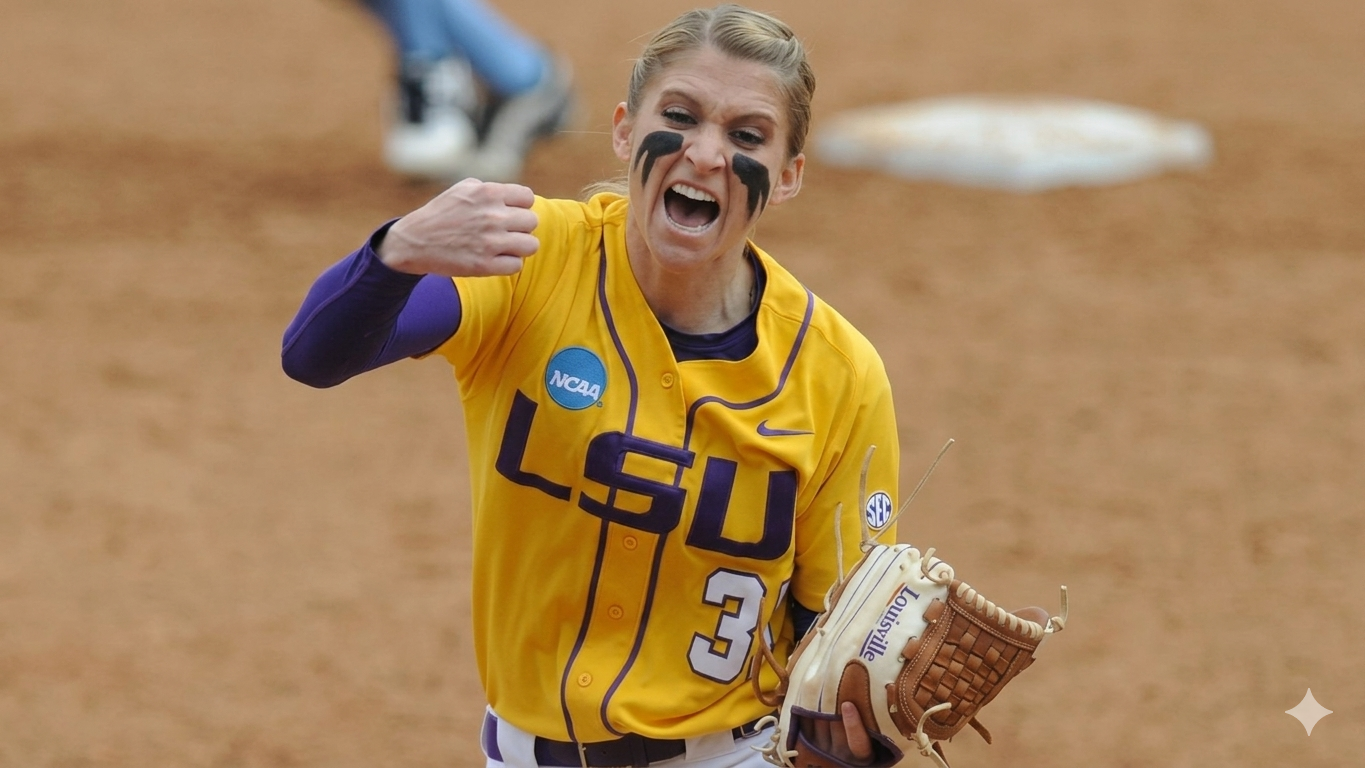
The story of Rachele Fico is a collection of numbers so gaudy they almost feel like a glitch in a video game: 26 perfect games, 1,884 strikeouts, and a high school ERA of 0.07.
But when the Connecticut Sports Media Alliance honors her with the Gold Key next month at the Aqua Turf Club in Southington, they aren’t just honoring a stat sheet. They are honoring a journey that began with tears on the way to T-ball and has culminated in a quiet high school classroom in Georgia, where one of the greatest athletes to ever come out of the Nutmeg State now spends her days as a special education teacher.
To understand the legend of Rachele Fico, you have to look past the bright lights of the SEC and the professional circles of the NPF and go back to the family’s backyard.
It was here that a young girl, who initially had to be pushed by her parents to even try the sport, found her niche.
“Honestly, when I was first signed up, I cried on the way to the field,” Fico said in an upcoming episode of “The Inside Corner Podcast,” recalling her start in the sport. “It’s not something that I wanted to do.”
Once she overcame that initial reluctance, a natural talent began to emerge—one that was fostered not by a high-priced academy, but by a father willing to sit on a bucket.
While other children were focused on post-game snacks, nine-year-old Rachele was already asking to go to the batting cages.

In those early years, she spent hours in the backyard with a pitchback, a simple net that returns the ball.
“I was out there just throwing the ball into the pitchback and it was going every which direction if I managed to hit it,” she said. “That’s when my dad came outside and asked me if I wanted him to catch for me.”
That moment sparked a partnership that lasted through the most prolific high school career in Connecticut history and followed her all the way to Louisiana State University. Her father, Ralph, who passed away in 2013, in Louisiana, the day afternoon the LSU was ousted from the NCAA tournament regionals, had become the silent anchor of her success.
“He was my main catcher on a daily basis through a portion of my high school career,” Rachele noted.
Even after she had become a nationally recognized star, the dynamic didn’t change.
“I remember coming home from winter break when I was at LSU and I asked him to come catch me at the cages and he did, no complaints,” she said. “I don’t think when I was younger, I realized what exactly he was doing for me, especially now that I end up catching for people and it’s difficult. I give him a lot of credit for that.”

By the time she reached Masuk High School, Fico wasn’t just a local standout; she was a phenomenon.
Over four years as a Panther, she compiled a record of 105–3. To maintain a 0.07 ERA meant that across her entire career, she allowed only three earned runs.
It was a level of dominance that felt impossible, yet she remained remarkably grounded. While fans and media fixated on the five consecutive perfect games she threw, Fico was focused on the girl standing next to her, or that girl out in the outfield, or in the dugout cheering her and the other starters on to victory.
“When I think about my high school career, my memories of it aren’t the stats,” she said. “It’s the time, the moments with my teammates, the inside jokes, everything that came with that is more so about the relationships that makes it so meaningful to me.”
The recruiting process that followed was a precursor to the modern era of the sport.
While today’s athletes rely on viral social media clips, Fico’s breakthrough came the old-fashioned way: by lighting up a radar gun at showcases and relying on raw game film.

Ironically, the tape that helped get her to the SEC wasn’t a sleek highlight reel, but footage from her time in the Little League World Series (Big League division) that had aired on ESPN.
“I just sent them my game film,” she laughed. “I did send them Little League film.”
When it came time to choose a college, Fico was torn between staying in Connecticut or heading to the powerhouse SEC.
She was on the verge of committing to Alabama when a “higher power” seemed to intervene.
As she and her father pulled into their hotel parking lot after the Alabama visit, when Fico was ready to commit to roll with the Tide, they found a giant LSU coach bus sitting right in front of them.
“Are you sure you just don’t want to go see it?” her father asked, referring to the official visit Fico had coming up to LSU.
The pitcher agreed, mostly to give him peace of mind. But once she stepped onto the campus in Baton Rouge, the decision was made.
“It just felt different,” she said. “When you know, you know, and it felt like home.”

At LSU, the stakes were higher and the pressure more intense. She went from being the big fish in a small pond to facing the best hitters in the world every weekend. It was an environment that demanded she grow not just as a player, but as a representative of something bigger.
“You’re not just representing yourself, you’re not just representing your family, you’re representing this school,” she explained.
She rose to the challenge, becoming a two-time NFCA First-Team All-American and leading the Tigers to the Women’s College World Series in 2012.

After a successful seven-year professional career, Fico made a pivot that surprised many but felt perfectly natural to her. She moved into the world of education.
In 2026, she is found in the Athens, Georgia area, working as a special education teacher.
The transition from the pitching circle to the classroom was fueled by a desire to make the same kind of impact her coaches once made on her.
“I just enjoy going to my job every day and seeing my students and trying to make a difference in their lives,” she said.
Though she is hundreds of miles away from Monroe, softball remains a constant. She helps coaches the high school teams and conducts one-on-one training, passing on the “spin guru” wisdom she learned from legendary mentors like John Stratton of the Stratford Brakettes.
“I don’t think there’s going to be a point in my life, at least for a long while, where I am not giving back to the game,” she said. “I enjoy making an impact on kids and trying to help create the pathway for them to achieve their dreams, whatever they may look like.”
Next month, the trip back to Connecticut will be a whirlwind. With the school year winding down and her students facing finals, Fico admits it will be a “very quick trip.” But the significance of the Gold Key is not lost on her.
The award places her in the company of the greatest sports figures in Connecticut history, a “rarefied air” that she approaches with characteristic humility.
“It’s an incredible honor, and I am so grateful to be recognized amongst some of the biggest contributors to Connecticut sports,” she said. “But this is not something that I have earned on my own accord. It has been something that people along the way have helped me to achieve. I am incredibly grateful for everyone who has been a part of my softball journey.”
As she prepares to stand on that stage, Rachele Fico won’t be thinking about the 1,884 strikeouts. She will be thinking about the father who caught for her in the winter cold, the teammates who “locked arms” with her in the dugout, and the students in Georgia she’ll be returning to the following the ceremony.
The Gold Key honors a legendary pitcher, but Rachele Fico has proven that her greatest legacy is her heart for the team—whether that team is on a dirt diamond or in a high school classroom in Athens, Ga., where the stats are secondary to the people who surround her.
• • •
The 83rd Gold Key dinner, presented by the Connecticut Sports Media Alliance (CSMA), will be held on Sunday, May 17, beginning at 2 p.m. at the Aqua Turf Club in the Plantsville section of Southington. Tickets sold for the original banquet date will be honored in May. Tickets are $80 and may be reserved by contacting Alliance member John Holt by email at JohnDHolt@yahoo.com or by phone at 508-740-4738.

Love Stories Like This?
Get Connecticut’s best softball features, breaking news, recruiting updates and exclusive interviews delivered to your inbox every Friday morning. Subscribe to the CT Softball Blog Weekly.



Leave a Reply