
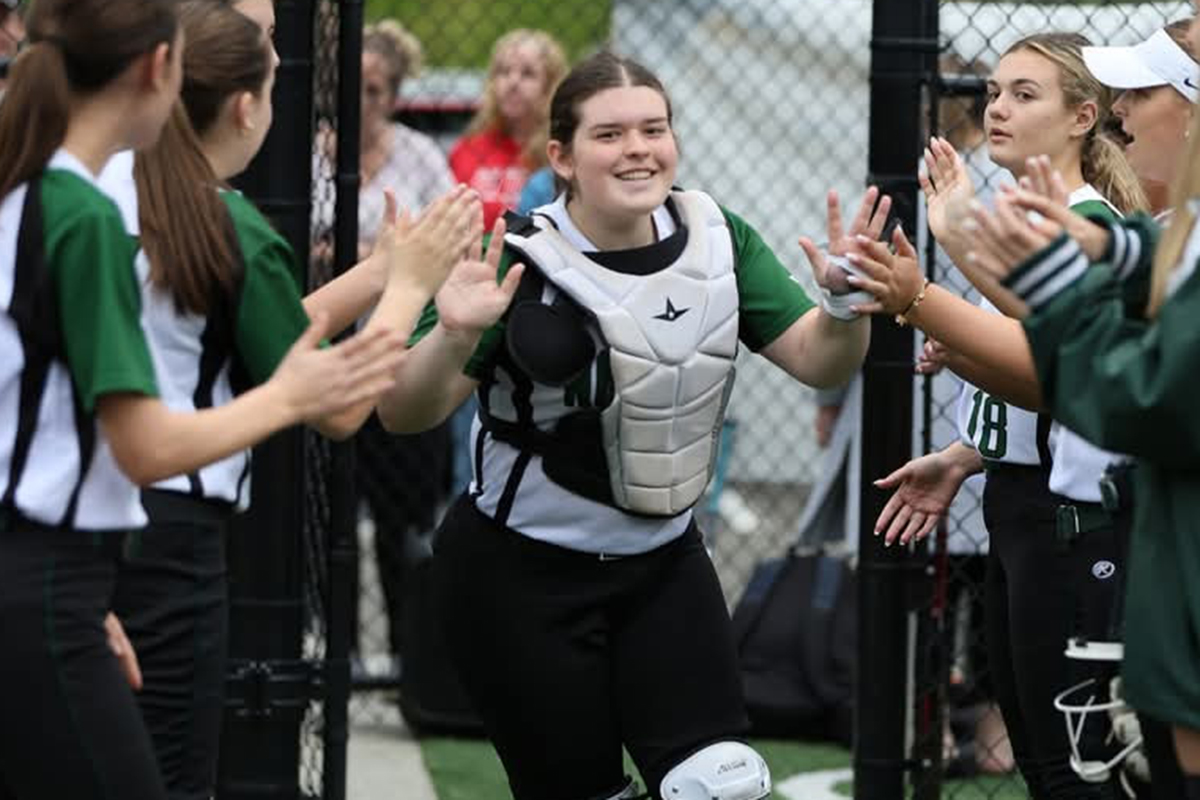
NORWALK — A rainbow Ring Pop changed Maggie Donahue’s life.
Seriously.
Years before she would become a catcher. Years before she would graduate from Norwalk High School with a 4.2 GPA. Years before Dean College came calling, asking her to come play softball at the next level.
It was even before she would spend two years of her life fighting battles far bigger than softball, a game she would have to leave behind.
Back then, Maggie was just a kid who had no interest in putting on the gear.
Until one day an 8U coach—her mother, Julie—made her an offer.
Catch one game and there would be a Ring Pop waiting afterward.
“I really liked rainbow,” Donahue said with a laugh.
One game turned into another.
And somewhere along the way, Maggie Donahue became a catcher.
But softball would eventually become much more than a position.
It would become hope.
It would become motivation.
And eventually, it would help bring her home.
Because there was a time when Maggie wasn’t sure she would even live long enough to see high school.
“I didn’t think I was going to make it to 13,” she said quietly.

Like many stories involving mental health, this one didn’t announce itself.
It whispered.
Maggie was in seventh grade.
Her parents, Julie and Chris Donahue, thought they were seeing what every parent sees from time to time. Mood swings. Withdrawal. The beginning of puberty.
Nothing seemed unusual.
Nothing screamed crisis.
“We missed everything,” Julie admitted. “I wasn’t looking for that at all.”
What her parents didn’t know was that their daughter had begun cutting herself. She was struggling with depression. She was binge eating as a coping mechanism. And she was carrying those burdens completely alone.
Then came a routine depression screening during a pediatrician visit.
Maggie sat there staring at the form.
She texted her older sister.
“Do I be honest?” she asked.
Her sister’s answer changed everything.
“I think you should.”
She was.
And suddenly, a secret that had been hidden inside one little girl exploded into the open.

“There was a big talk,” Maggie said. “And it just snowballed from there.”
The first hospital visit came soon afterward.
Then another.
And another.
Eventually there would be six different stays.
St. Vincent’s.
Silver Hill.
New York Presbyterian.
Days became weeks.
Weeks became months.
And Chris and Julie found themselves living every parent’s nightmare. Their daughter was having thoughts of suicide.
“We had locked up everything sharp in the house,” Chris said. “We had locked up all the medicine.”
They bought lock boxes.
Knives disappeared.
Scissors disappeared.
But none of that hurt as much as the feeling neither parent could escape.
“The idea that you can’t help your child is incredibly frustrating,” Chris said. “You spend the whole time second guessing everything you’ve done.”
He remembers visiting his daughter in the hospital.
Then making the hour-and-a-half drive home wondering what he had done wrong.
“How did I screw up so bad that my kid is there and not sitting in a car with me?” he asked.
The truth?
He hadn’t.
Neither had Julie.
Mental illness doesn’t care how much parents love their children. And they loved Maggie enough to do whatever was necessary.
Even when it meant sending their daughter away.

Eventually, Maggie spent three months in a wilderness therapy program in North Carolina.
She hated it.
She feared for her safety. Some of the kids there were being treated for homicidal tendencies. The camp has since been closed due multiple deaths of patients over the years.
While there, communication with home came through letters.
Sometimes weeks apart.
Once she completed her time at the now-defunct wilderness program, next came Asheville Academy for Girls, a therapeutic boarding school.
For a year, North Carolina became home.
And Connecticut became something she missed with all her heart.
Including softball.
“I wanted to come home, and I wanted to play ball,” Maggie said.
Over and over, that became her goal. Not another private school. Not an easier path. Norwalk High School. Her friends. And softball.
The therapists recommended smaller schools. Special programs. Safer environments.
Maggie had other ideas.
“I want to go back to Norwalk High,” she told everyone.
She planted her feet. And she refused to move. Like any good catcher would.

By the time Maggie came home, she hadn’t played softball in almost two years.
No throwing. No hitting. No catching. Nothing.
“I had to basically relearn the game,” she said.
Her mechanics were gone. Her arm was different. Her swing was different.
Only recently, she says, has she truly learned how to throw again.
But softball wasn’t just about softball anymore.
It represented something bigger.
Normalcy.
“I wanted a normal life,” she said. “I wanted normal friends. I wanted to be normal.”
Norwalk High and her support system made sure she had a chance.
There were meetings.Extra breaks during the school day. Regular visits with social workers.
No honors classes initially, but that lasted just a few weeks.
“I can’t do this,” Maggie finally told administrators. “These classes are too easy.”
Slowly, more honors courses were added. Then AP classes. By graduation, she had six AP classes under her belt.
She graduated magna cum laude, earning a 4.2 GPA.
And, recently, she stood before students at her elementary school after winning a scholarship and gave a speech.
A girl who once wondered whether she’d live to see 13 was now inspiring others.
“You go from nights of crying yourself to sleep because you don’t know what tomorrow holds,” Julie said, “to seeing everything so bright for her now.”
“And she did all the work.”

Somewhere during those years, something else happened.
Maggie began talking about her struggles.
After missing a couple of weekends with her travel team, she returned and was sitting with teammates when one girl asked where she had been.
Maggie grabbed her helmet, got ready to hit and answered matter-of-factly: “I was in a mental hospital.”
Then she walked out to hit.
No explanation. No speech. Just the truth.
The player’s mom told Maggie’s mom what Maggie said, and Julie admitted it was true.
A short time later, that teammate told her own parents she was struggling and needed help.
Eventually, her father shared something with the Donahues that Julie has never forgotten.
“Thank Maggie,” he said.
Because after hearing Maggie speak so openly, his daughter had found the courage to do the same.
Maggie didn’t even know about that until she sat down for the interview for this story.
In simply trying to survive, she had unknowingly helped somebody else.
“Maggie helped her,” Julie said.
“Use this experience for good,” she told her daughter. “You’re probably going to help somebody.”

That’s why Maggie wanted to tell this story.
Not for sympathy. Not for attention.
But because somewhere, another seventh grader may be staring at a depression screening form.
Another kid may be hiding cuts. Another family may feel completely lost.
Maggie wants them to know there is hope.
“There is light at the end of the tunnel,” she said. “It does ease with time and effort.”
She still takes medication. She still has tough days. She still understands those feelings.
But now she knows something she didn’t know when she was 12 years old.
She knows how to get through them.
And maybe that’s what recovery really looks like.
Not perfection. Not pretending the darkness never existed.
Just learning how to live with the clouds from time to time without letting them block out the sun.

Last week, Maggie Donahue graduated from Norwalk High School.
Soon, she will head to Dean College in Massachusetts, where she’ll study athletic training and continue her softball career.
Her mother overflows with pride.
Her father still occasionally wakes up in the middle of the night worrying.
Because that’s what parents do.
But graduation morning, Chris dropped his daughter off at school and said something simple.
“See you at graduation,” he told her. “I’m proud of you.”
And maybe there is no greater victory than that.
Not the GPA. Not the catches or caught stealing statistics. Not the extra base hits or the slugging percentages. Not even the wins. Not even college softball.
Just a father telling the daughter he could have lost how proud he is of her.
The road to that diploma had no map 18 years ago when Maggie Donahue was born into this world, not knowing the obstacles she would have to overcome to make her dreams come true.
But Maggie Donahue found her way home so not only could all her dreams come true, but maybe her story might help somebody else, as well.
(EDITOR’S NOTE—If you or someone you know is struggling with depression, thoughts of self-harm or suicide, please know that help is available and you are not alone. Call or text 988 anytime to reach the Suicide & Crisis Lifeline, or visit 988lifeline.org to chat with a trained counselor. The first step is often the hardest, but as Maggie’s story shows, there is hope and there are people ready to help.


Leave a Reply